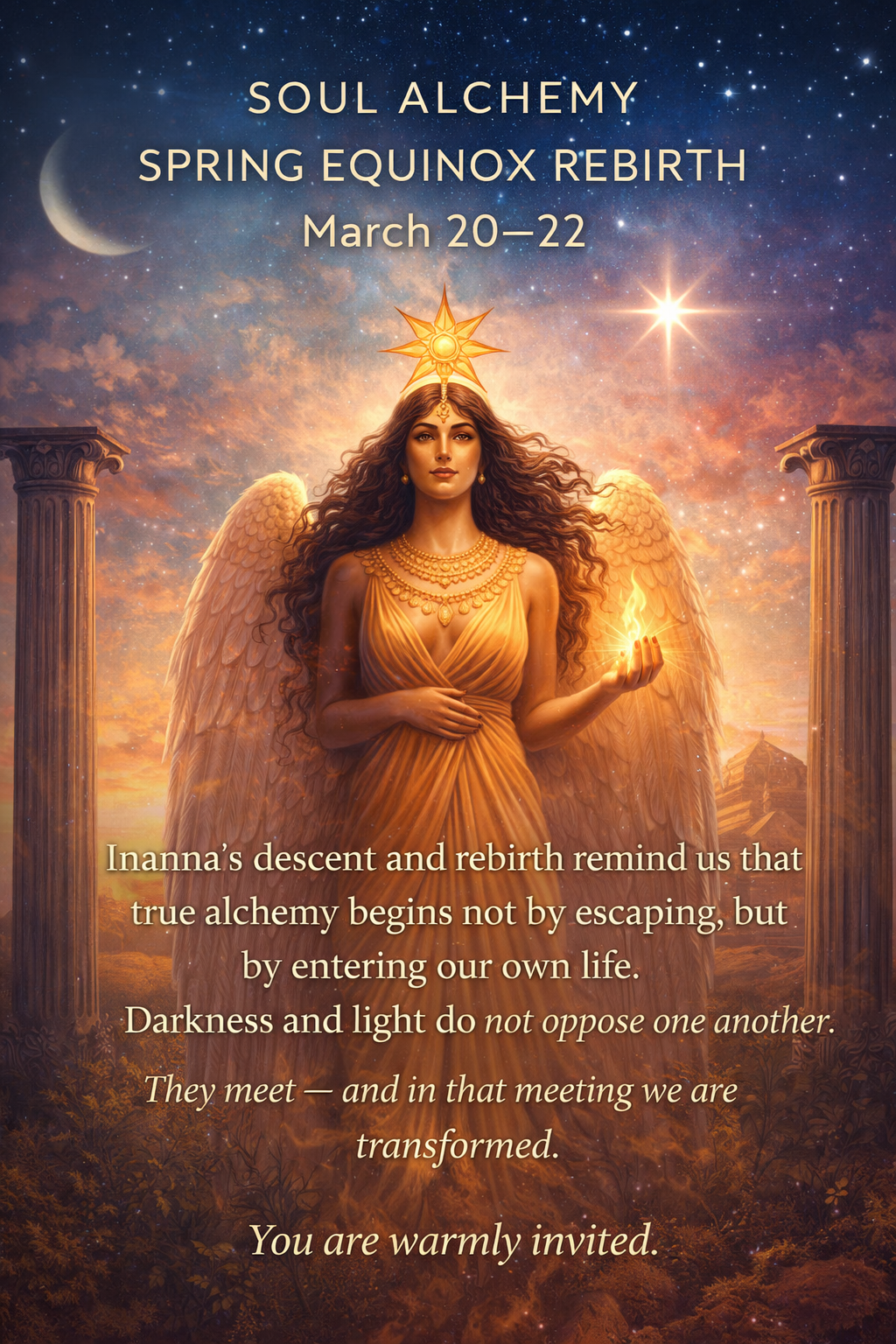
Soul Alchemy Rebirth Through the Descent
The story of the Goddess Inanna
Soul Alchemy
Rebirth Through the Descent
Inanna, later remembered as Ishtar and aligned with the cycles of Venus, is the ancient pulse of descent and return woven into the human soul. She is the call that draws us inward, beyond the identities we have worn, into the hidden chambers of grief, longing, and truth. In her journey, we witness the sacred unraveling, the shedding of what is not essential so that the sovereign, untamed essence within us may rise again. Her myth is not a story of loss, but of remembrance: the courage to walk into the dark and emerge carrying our own light.
Her story emerges like an ancient memory still held within the earth, a remembrance of the soul’s deep longing, where devotion and fierceness live side by side, where tenderness is not separate from strength, and where we are invited to hold both our light and our shadow as one sacred, breathing whole.
In some streams of mystical understanding, her presence is felt as the current of what is called Venus consciousness, a frequency of divine intelligence, beauty, and awakened heart. Alongside this current is her twin flame, known as Sanat Kumara, the steady keeper of Venusian wisdom, carrying the living spark often called the Christ seed or trifold flame — the union of love, wisdom, and sacred will, alive within the heart’s center.
Rather than meeting them as distant figures beyond ourselves, we are invited to recognize these presences as living qualities already stirring within, expressions of our own heart, our own strength, our own awakened awareness waiting to be embodied. The Christ seed is the quiet spark of unconditional love that has never left us, the capacity for compassion made real through how we live and respond.
The trifold flame is felt as three currents moving together within the heart’s field: the warmth of loving-kindness, the clarity of true seeing, and the steady guidance of aligned will not separate, but are woven as one living light.
When we speak of Lady Venus and Sanat Kumara in this space, we are speaking of welcoming their qualities as lived experience, allowing them to awaken within the body itself. They are felt as a gentle warmth in the heart, a quiet steadiness rising through the spine, a clarity that guides our choices, and a softening of the places that once guarded or resisted. This is not something to believe in, but something to embody, to let become real through sensation, presence, and awareness.
The teaching is simple, though not always easy: Rebirth does not come from turning away from pain. It comes from meeting it with honesty, allowing what has been hidden to be seen, held, and transformed in the light of our own attention.
Just as Inanna chose to descend, we too are invited to face what we have avoided — grief, fear, unmet needs, identities that no longer fit. Rebirth is not about becoming someone else. It is about returning to who we were before we learned to shrink, protect, or perform for love.
Descent precedes rebirth because wholeness asks us to gather every part of ourselves back into the heart.
She chooses the underworld. No one forces her. She feels the pull of something unfinished and turns toward it rather than away.
At each gate, she removes a layer: the crown that told the world who she was, the jewels that reflected her value, the garments that signaled her status. Piece by piece, what she believed defined her falls away.
By the time she stands in the dark before her sister in the underworld, she is no longer protected by titles, beauty, or authority. She is simply herself, vulnerable, exposed, and real.
And there she experiences a kind of death:
the death of image,
the death of control,
the death of certainty.
But what dies is not her essence.
What dies is what she no longer needs.
When she returns, she carries the memory of the dark, compassion for suffering, humility where pride once stood. She returns altered, having faced herself without adornment.
True rebirth is not escape.
It is integration.
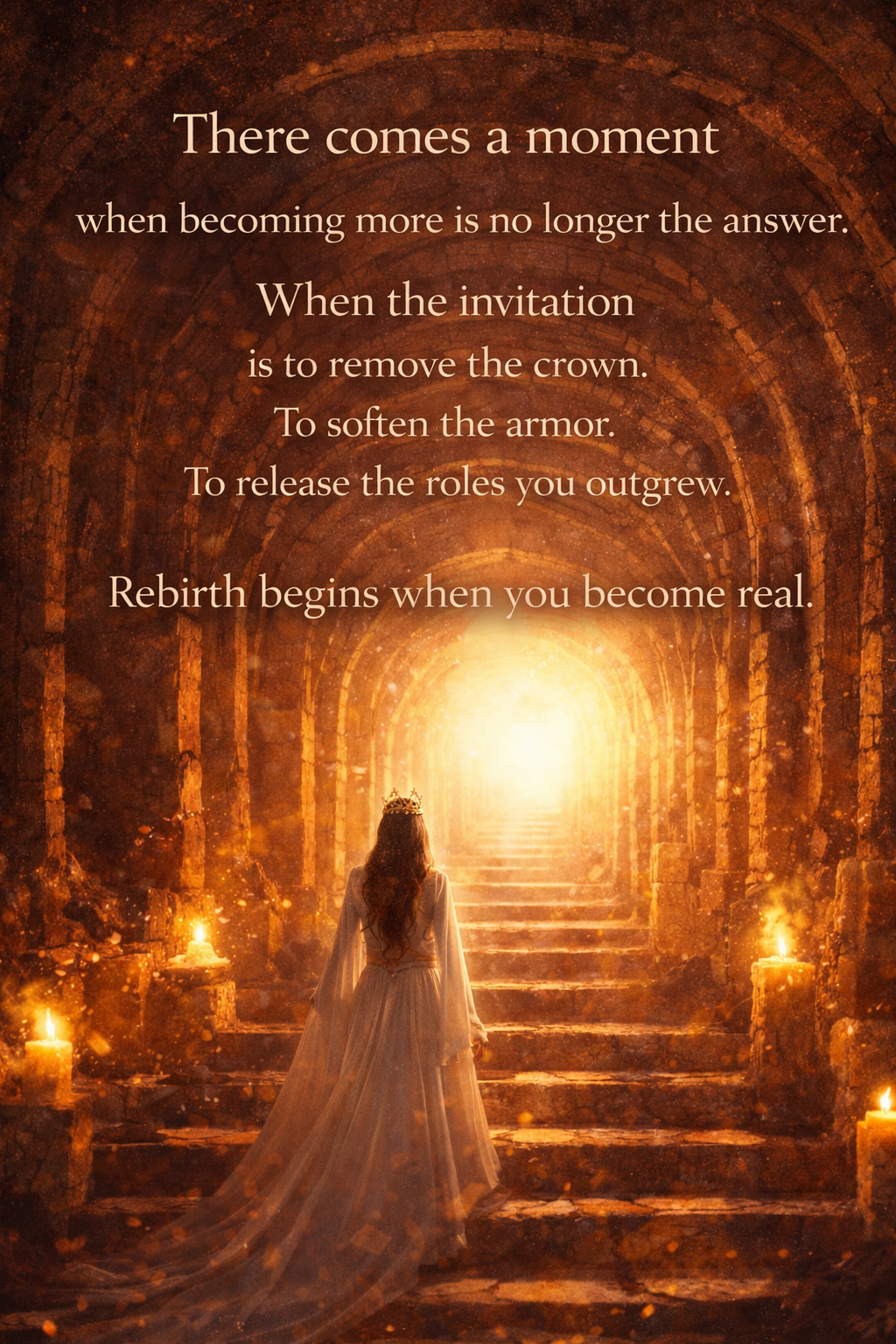
The Seven Gates
A Map for Our Own Transformation
Inanna’s descent unfolds through seven gates. At each one, something is removed. The process is intentional. Nothing is taken all at once. Identity is revealed layer by layer.
First Gate — The Crown
She releases the need to appear strong, impressive, or in control.
Second Gate — The Earrings
She questions the voices she has listened to and the beliefs she has carried.
Third Gate — The Necklace
She loosens attachment to what once felt precious but is no longer true.
Fourth Gate — The Breastplate
She allows the guarded heart to soften and risks feeling without armor.
Fifth Gate — The Ring
She examines old vows, roles, and agreements formed from fear or obligation.
Sixth Gate — Control
She lets go of the need to manage everything and discovers trust instead of tension.
Seventh Gate — The Final Garment
She lets go of the image she presented to the world and stands simply as herself.
Not humiliated.
Not broken.
But unadorned. Real.
This is not a weakness.
It is courage.
A Reflection for Our Own Lives
If life were inviting you through seven gates, what might be ready to soften or release?
What identity feels complete?
What belief no longer feels true in your body?
What protection can now be relaxed?
What role feels misaligned with who you are becoming?
What need for control is asking to be surrendered?
What mask have you outgrown?
Rebirth is rarely dramatic.
It is often quiet. Honest. Gradual. It is the moment we stop resisting the descent and allow it to reshape us.
The Return-Rising Through the Seven Gates
In the ancient story, Inanna does not remain in the underworld.
After surrendering everything she believed herself to be, after standing stripped of identity and certainty, she is given permission to return. But she does not ascend as the same being who descended.
She rises changed.
The journey upward is not about reclaiming what was lost. It is about receiving new understanding — gifts born from having faced the dark without turning away.
If the descent is the unraveling, the ascent is the integration.
We, too, must learn how to return.
The First Gate — The Gift of Humility
At the place where her crown was removed, she does not take back authority in the old way. She receives a new relationship with power. No longer power as control, but power as presence. The ability to stand without needing to prove.
The Second Gate — The Gift of Inner Listening
Where she once surrendered her earrings — symbols of what she heard and believed — she now returns with discernment. She no longer lives by inherited voices. She listens inwardly to her own inner wisdom.
The Third Gate — The Gift of Right Relationship
Where the necklace once defined what was precious, she now understands value differently. Worth is no longer attached to role, approval, or possession.
The Fourth Gate — The Gift of the Open Heart
Where her breastplate was removed, she does not rebuild armor. She learns how to remain open without losing herself. This is the courage of tenderness — strength that does not close.
The Fifth Gate — The Gift of Conscious Choice
Where vows and roles once bound her, she now chooses deliberately. She is no longer compelled by obligation. She participates in her life rather than performs it.
The Sixth Gate — The Gift of Trust
Where control was relinquished, she does not regain certainty. She gains trust in movement, in timing, in unfolding.
The Seventh Gate — The Gift of Wholeness
At the final gate, she does not put the old garments back on in the same way. She carries them differently. Identity becomes something she wears lightly. She remembers who she is beneath every role.
Rebirth Is Not a Return to the Past
Her story reminds us that rebirth is not a return to who we once were, but an awakening to walk between worlds, to live within the ordinary rhythms of life while carrying the quiet wisdom gathered in the dark. We descend many times in a lifetime. Yet we are also called to rise, again and again. Rebirth is not the moment we leave the underworld. It is the moment we bring our knowing back into how we live, how we choose, how we love. And so this story turns gently toward you.
Where in your life are you being asked to begin again?
What have you outgrown, even if you have not yet set it down?
What truth is waiting for your acknowledgment?
What would it feel like to move forward carrying less armor and more presence?
You do not need to force a transformation.
Simply listen.
Notice what is ready to soften.
Take one honest step.
Rebirth rarely arrives as a dramatic moment.
More often, it begins as a quiet decision to live differently — here, now, in the life already before you.
Let this be that threshold.
Much love
Kellie AmaLiana Japhriel
May you walk forward with courage enough to release what is finished,
and tenderness enough to welcome what is waiting to be born